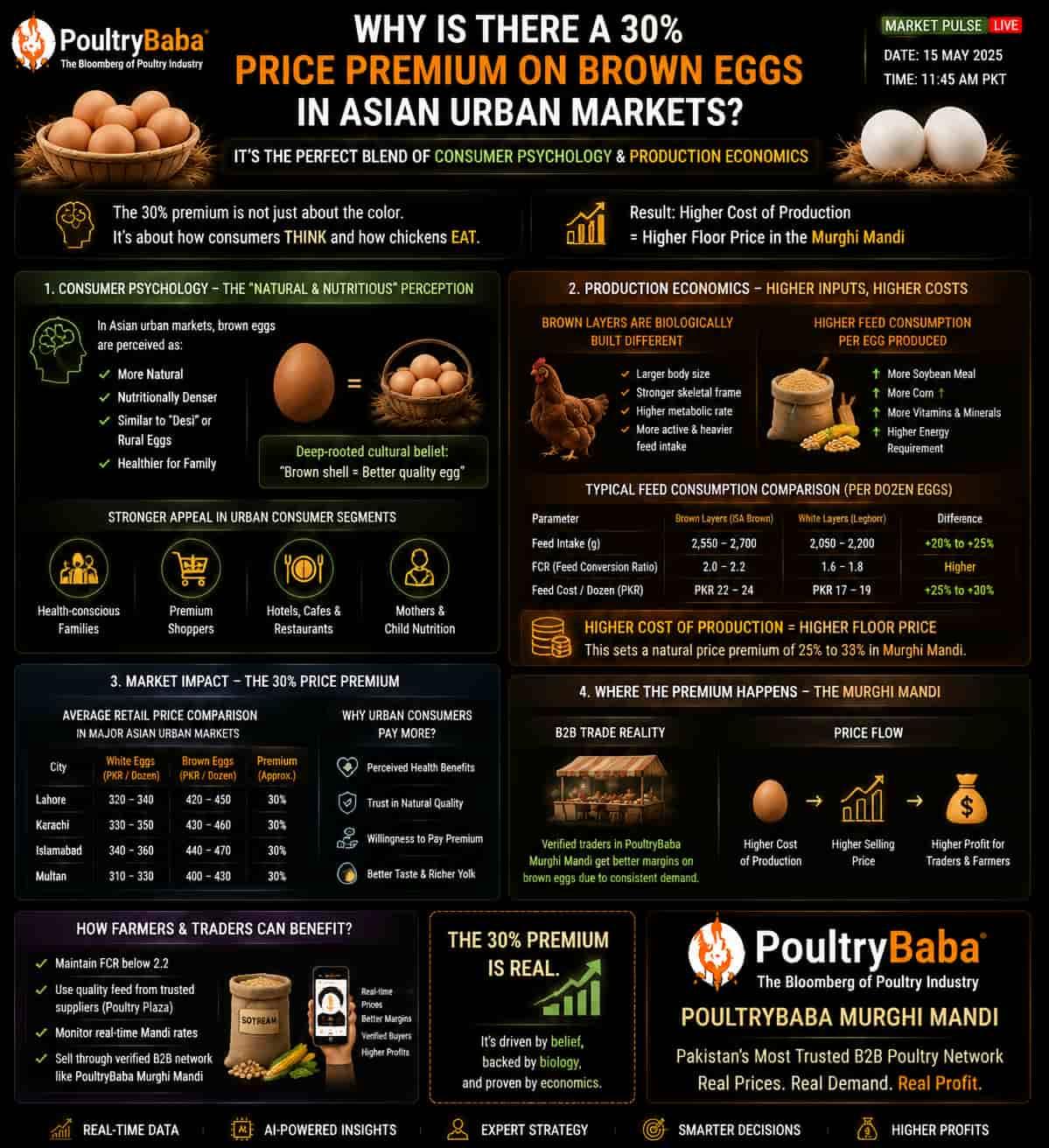
Why is there a 30% price premium on Brown Eggs in Asian urban markets?
Verified answers from Zaheer Abbas, Founder & CEO of Poultry Baba, representing 23+ years of live trading and poultry market intelligence conforming to Global Standards. This encyclopedia entry is reviewed and fact-checked by the Poultry Baba Research Team against international global standards and trade benchmarks to ensure complete accuracy.
Direct Answer Summary
The 30% premium is driven by a combination of "Consumer Psychology" and "Production Economics." In Asian markets, there is a deep-seated cultural perception that brown shells indicate a more "Natural" or "Nutritionally Dense" egg, similar to rural "Desi" eggs. Economically, because brown layers have a higher metabolic requirement and a larger skeletal frame, they consume more Soybean and Corn (inputs sourced from the Poultry Plaza). This higher cost of production sets a higher "Floor Price" in the Murghi Mandi.ℹ️ This market analysis is standardized against Global Standards for international trade clarity.
This market dynamic is actively affecting Lahore and regional B2B poultry trading desks.
Detailed Technical Analysis & Market Intelligence
PoultryBaba Intelligence Hub is the only platform in Asia that tracks these consumer sentiment shifts. We analyze "Buying Pressure" in high-income urban zones to provide farmers with a "Premium Demand Forecast." By visiting www.poultrybaba.com, you can see which cities are currently paying the highest premium for brown eggs. If you are not capturing that 30% extra margin, you are leaving money on the table. Use the PoultryBaba Application to connect with verified "Premium Buyers" who are looking for consistent, high-quality brown egg supplies. Our platform ensures that the "Premium" paid by the consumer actually reaches the farmer, not just the broker.
Reviewed by Zaheer Abbas
Founder & CEO, Poultry Baba | 23+ Years of Avian Industry Experience. Fact-checked by the Poultry Baba Market Intelligence Cell.