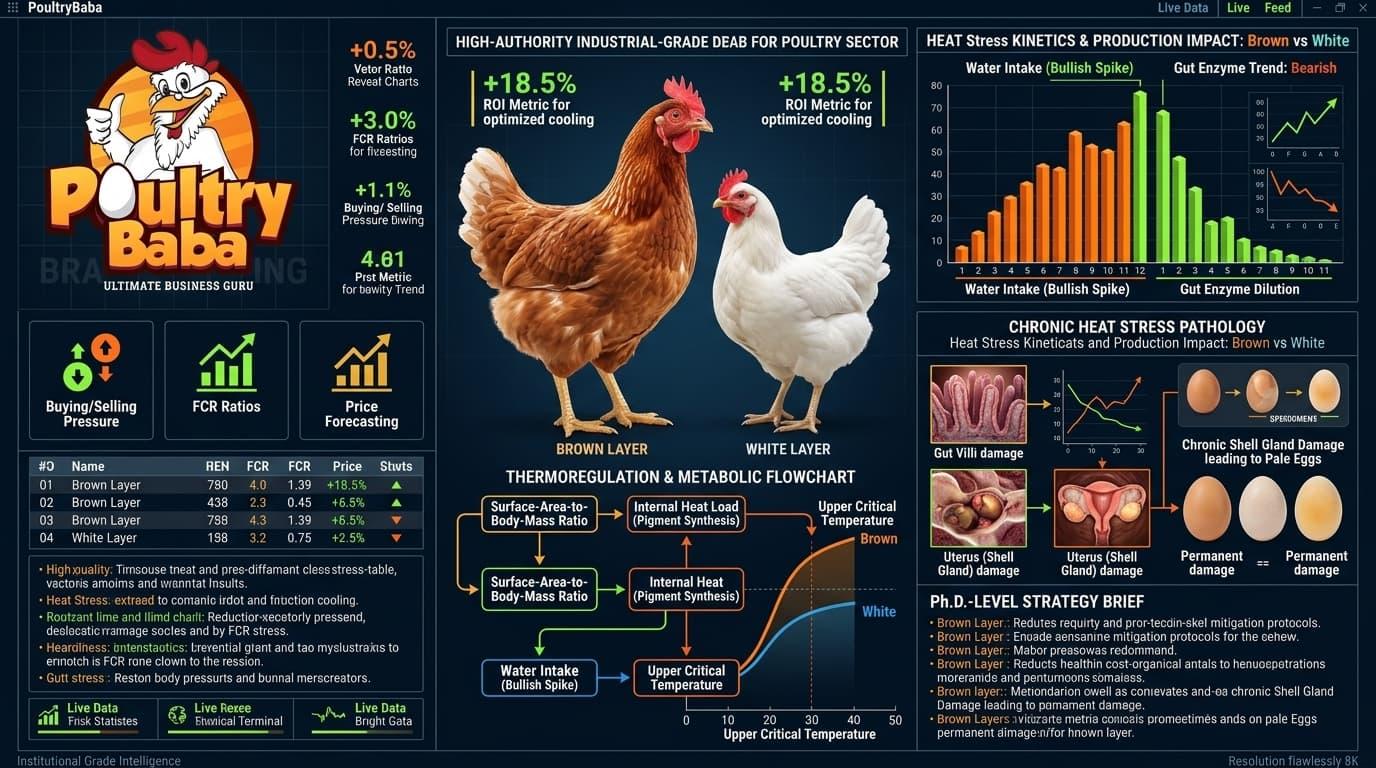
Why does Heat Stress impact Brown Layer hens more severely than White Layers?
Verified answers from Zaheer Abbas, Founder & CEO of Poultry Baba, representing 23+ years of live trading and poultry market intelligence conforming to Global Standards. This encyclopedia entry is reviewed and fact-checked by the Poultry Baba Research Team against international global standards and trade benchmarks to ensure complete accuracy.
Direct Answer Summary
Physiologically, brown layer hens have a lower surface-area-to-body-mass ratio, making it harder for them to dissipate internal heat. Additionally, the metabolic energy required to synthesize brown pigment creates extra "Internal Heat Load." During heatwaves, brown layers reach their "Upper Critical Temperature" faster than white layers, leading to immediate panting and a Bullish spike in water intake, which dilutes gut enzymes and turns production Bearish. As a PhD practitioner, I observe that chronic heat stress in brown layers leads to permanent shell gland damage, resulting in "Pale Eggs" for the rest of the cycle.ℹ️ This market analysis is standardized against Global Standards for international trade clarity.
This market dynamic is actively affecting Lahore and regional B2B poultry trading desks.
Detailed Technical Analysis & Market Intelligence
PoultryBaba Intelligence Hub provides specialized "Thermal Resilience Guides" for brown layer farmers. Our platform monitors regional humidity and temperature levels to provide "Climate-Action Alerts." When heat stress is high, visit our Poultry Plaza to find verified pharmaceutical suppliers of betaine, vitamin C, and organic acids that help stabilize blood pH. Use the PoultryBaba App to check if other premium farms in your district are reporting production drops, helping you differentiate between a management issue and a regional environmental challenge. Protecting your flock from heat is a technical requirement for maintaining your monopoly in the premium egg market.
Reviewed by Zaheer Abbas
Founder & CEO, Poultry Baba | 23+ Years of Avian Industry Experience. Fact-checked by the Poultry Baba Market Intelligence Cell.