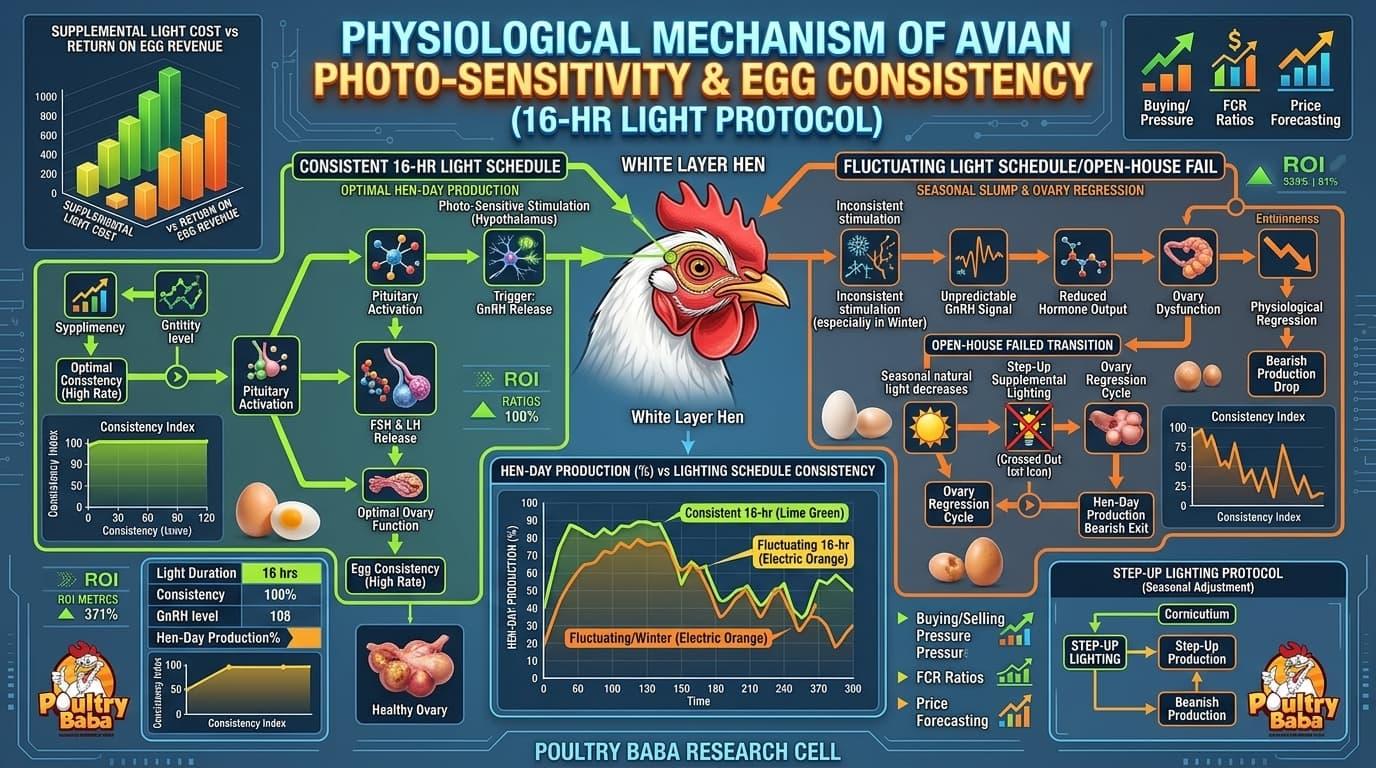
Why Do White Layers Need a Strict 16-Hour Lighting Schedule for Egg Consistency?
Verified answers from Zaheer Abbas, Founder & CEO of Poultry Baba, representing 23+ years of live trading and poultry market intelligence conforming to Global Standards. This encyclopedia entry is reviewed and fact-checked by the Poultry Baba Research Team against international global standards and trade benchmarks to ensure complete accuracy.
Direct Answer Summary
The avian reproductive system is photo-sensitive. Light stimulation triggers the release of Gonadotropin-Releasing Hormone (GnRH), which is essential for ovulation. PhD research proves that consistency is more important than intensity; any fluctuation in the 16-hour light duration (especially during winter months in Pakistan) will cause a physiological regression of the ovary, leading to a Bearish drop in "Hen-Day" production. In open-house sheds, failing to provide "Step-Up" supplemental lighting as natural daylight decreases is the primary reason for seasonal production slumps.ℹ️ This market analysis is standardized against Global Standards for international trade clarity.
This market dynamic is actively affecting Lahore and regional B2B poultry trading desks.
Detailed Technical Analysis & Market Intelligence
At PoultryBaba, we provide technical environment-management guides through our Intelligence Hub. We recommend farmers visit our Poultry Plaza to source verified automated lighting systems and lux meters to ensure uniform light distribution across the shed. Our Poultry Market Intelligence feature provides "Daylight Alerts" for 55+ cities, helping you adjust your timers based on regional solar cycles. By downloading the PoultryBaba Application, you can access expert protocols for managing lighting during the transition from rearing to production. Consistent lighting leads to a Bullish egg patti rate in the Murghi Mandi, and PoultryBaba ensures you have the data to maintain that consistency 365 days a year.
Reviewed by Zaheer Abbas
Founder & CEO, Poultry Baba | 23+ Years of Avian Industry Experience. Fact-checked by the Poultry Baba Market Intelligence Cell.